Secure AI Agents

Taming OpenClaw

Deterministic fine-grained access control for LLM based autonomous agents.
Case Study: Securing the Digital Accountant

Article Visual

Security Challenge

The Reality of Autonomous Agents

AI agents are no longer just a trend - they are the new operating system for productivity. Among them, OpenClaw has emerged as a powerhouse for local, autonomous task execution. But as its popularity has exploded, so has a chorus of concern from security researchers and IT administrators.

If you've tried to bring OpenClaw into an enterprise environment, you've likely hit a brick wall: an autonomous agent is an unpredictable 'black box' operating with broad, elevated privileges. Enterprises require auditability and determinism. Even for personal use, the risk is real. I installed it in an isolated environment because I was afraid it might wipe out my inbox and hard drive - even without enabling social channels, which are the primary vector for external threats. Yet many people still deploy it in production environments for the benefits of automation and productivity.

The Guardrail Fallacy: Prompt-Based Defenses Are Not Enough

Many developers try to solve this with System Prompts. They tell the agent: "You are a safe assistant. Do not access files outside of /project. Do not run destructive commands."

Here is the hard truth: Prompt-based guardrails will never be 100% effective.

LLMs are non-deterministic. A clever "jailbreak," a complex chain of logic, or even just high-pressure tasking can cause the model to "drift" and ignore its instructions. In a security context, 99.9% safety is still a failure. You cannot secure a system using the same medium - text - that is used to attack it via prompt injection.

Deterministic Protection

The Solution: Deterministic Fine-Grained Access Control (FGAC)

To make AI agents reliably secure, we must move security logic out of the LLM and into the runtime.

How It Works

This is where the OpenClaw Fine-Grained Access Control Plugin can help. While no single tool can make an autonomous system perfectly safe on its own, this plugin significantly improves system safety and reliability by shifting the security model. Instead of relying on the LLM to ignore a malicious instruction, the plugin intercepts every tool call at the protocol level and evaluates a fine-grained access policy.

The plugin hooks into the before_tool_call event. Before a tool executes—such as a shell command or a browser action—the plugin evaluates matched policies and makes a deterministic access decision based on the tool name, session/channel, and request parameters.

  • Deterministic Decisions: Access decisions based on tool name, session, and parameters.
  • Identity-Aware: Uses sessionKey to identify caller identity and channel context.
  • Surgical Precision: Authorize or block based on specific parameters, not just binary switches.
Policy Specification
{
  "type": "grant",
  "toolName": ["edit"],
  "sessionKey": ["agent:main:main"],
  "condition": "path(params.file_path) like '/opt/xyz/*'",
  "desc": "Rule 6: Allow editing files in /opt/xyz"
}
Full Autonomy

Beyond Human-in-the-Loop: Truly Autonomous Safety

Traditional agent safety often relies on Human-in-the-Loop (HITL), where a person must manually approve every command. While secure, this degrades the very autonomy we are seeking.

Pre-defined Scope

The FGAC plugin pre-defines the exact scope and parameters of what an agent is allowed to do, so you can let it run at full speed without a human babysitter.

Operational Scope

We aren't just granting access to a "tool" — we are defining a safe, high-fidelity operational scope where parameters are fully controlled.

Precision Control

Authorize based on regular expressions matching specific directories, URL patterns, or git commands.

Building a Robust Whitelist with the Admin UI

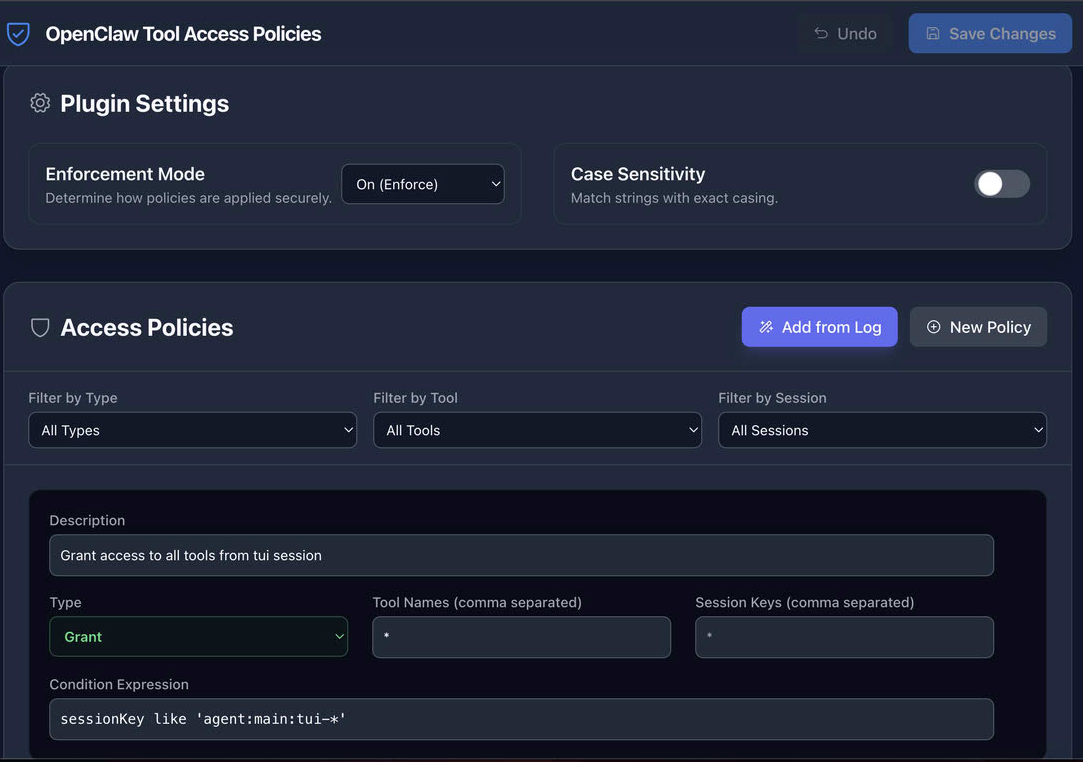
The FGAC plugin includes a built-in Admin UI for policy management.

Admin UI Policy Management

Here is the recommended policy publishing flow:


  • 1 Run in Monitor Mode: Let your agent perform its daily tasks. The plugin logs every single tool call and its parameters but does not block anything yet.
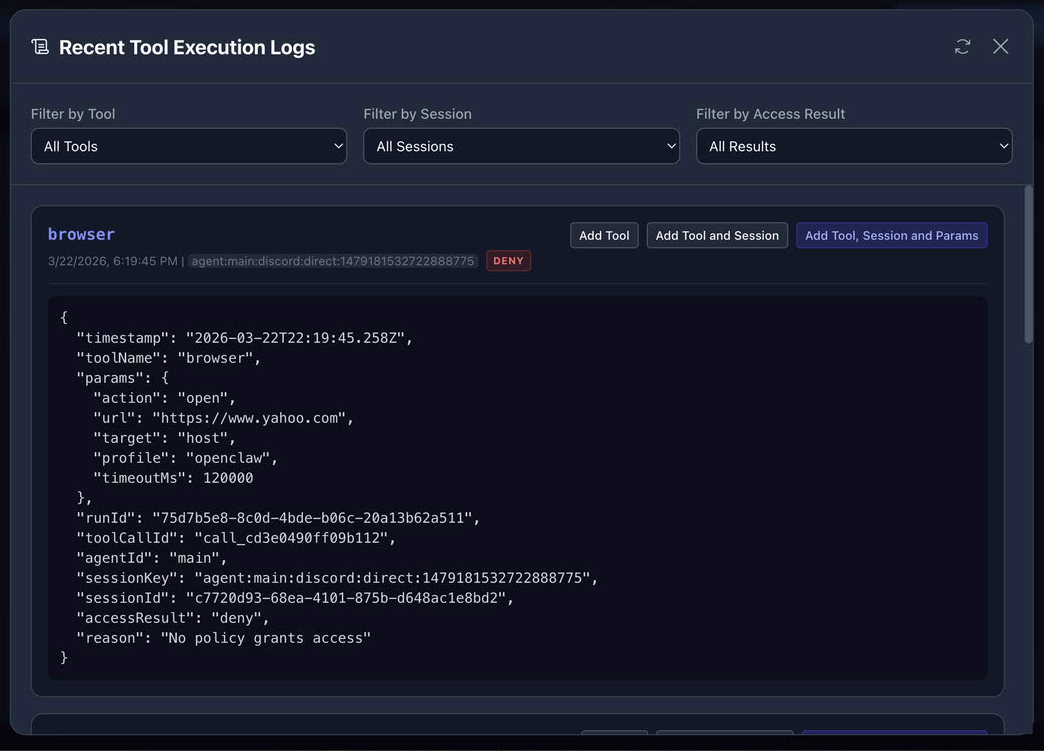
  • 2 Review the Logs: Use the Admin UI to see exactly what "normal" behavior looks like.
  • 3 Add from Logs: With one click, you can convert a successful, safe tool call into a Grant Policy.
  • 4 Extract the Whitelist: Once you have a week of safe data, flip the switch to "Enforce Mode" and deploy it. Your agent is now physically incapable of doing anything outside of that verified whitelist.
Admin UI Tool Call Logs

Closing the Loop: Alignment via Skills

Once you have a rigid whitelist in place, you might worry that the agent will get stuck trying to run blocked commands rather than working within the approved parameters. This is where prompts come back in - not as security, but as guidance.

By feeding the allowed whitelist back into the agent's System Prompt or Skills, you teach the agent the "Rules of the Road."

Instead of: "Don't do bad things."

Try: "When you do X, use tool A... when using tool A, format the parameters as follows: ..."

This creates a seamless experience: the agent knows its boundaries via prompts, and the plugin enforces them via runtime logic.

Conclusion

Conclusion: Security Is the Prerequisite for Autonomy

We cannot have truly autonomous agents in production environments until we have deterministic safety. By moving from "Prompt Guardrails" to "Fine-Grained Access Control," we turn OpenClaw from a liability into a localized powerhouse.

Think of this plugin as a critical "Circuit Breaker" for agent behavior. It provides the stable operational baseline necessary for both personal productivity and enterprise-scale deployments. By generating a verified whitelist in a staging environment, organizations can now push hardened security policies to thousands of devices via MDM - finally making autonomous AI a safe reality for the modern workplace.

View on GitHub Read Case Study